Music Is More Than a Special — It’s Brain Training in Disguise

When we talk about music education, it’s easy to picture concerts, recorders, glittery programs, and sweet little voices singing on stage. And yes… all of that is wonderful. But underneath the performance and creativity, something much deeper is happening.
Music is strengthening the very cognitive systems children rely on for reading and mathematics.
This isn’t just a “music teacher opinion.” Research in neuroscience and education consistently shows that music training enhances phonological awareness, pattern recognition, memory, spatial-temporal reasoning, and sequencing skills. Those aren’t bonus abilities. They’re foundational skills for literacy and math achievement.
Music isn’t separate from academics.
It is deeply connected to them.
Let’s break it down.
Music and Reading: Shared Pathways in the Brain
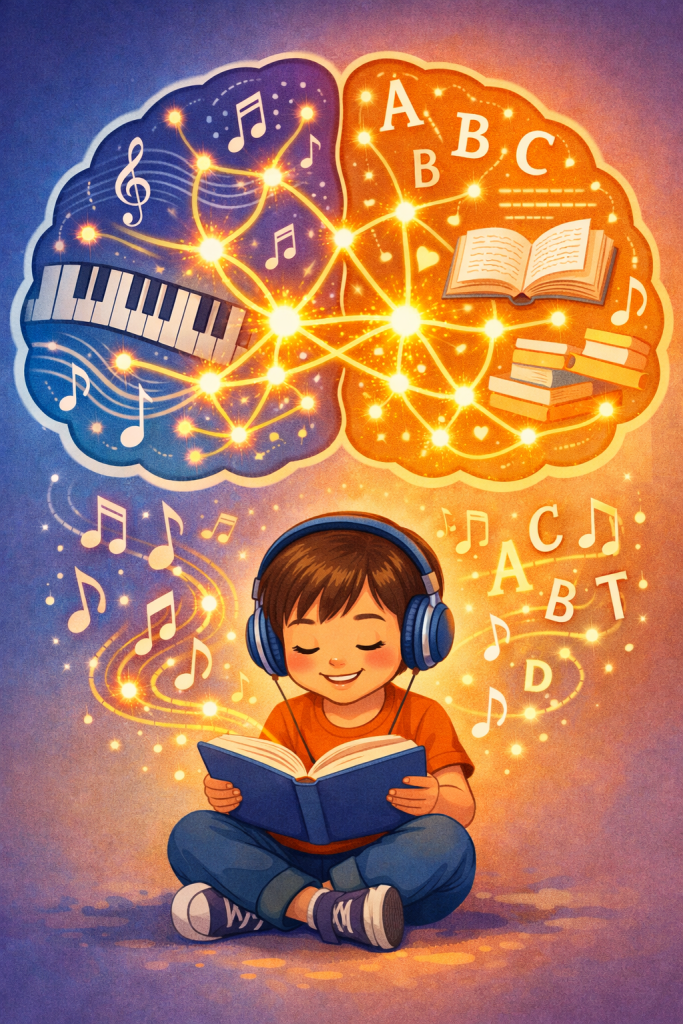
At first glance, music and reading may seem like completely different skills — one is artistic, the other academic. But inside the brain, they are closely connected. Both rely on the ability to process sound, recognize patterns, interpret symbols, and sequence information in meaningful ways. When children engage in music training, they aren’t just learning songs — they are strengthening the neural networks that support literacy development.
1. Phonological Awareness: Training the Ear for Language
One of the strongest predictors of early reading success is phonological awareness — the ability to hear and manipulate sounds in spoken language.
Music training sharpens auditory discrimination. When children learn to distinguish:
- High and low pitches
- Long and short sounds
- Subtle rhythmic differences
They are strengthening the same neural pathways used to distinguish between speech sounds like /b/ and /p/.
Clapping syllables in a rhyme and clapping rhythmic patterns in music activate overlapping brain systems. When those skills converge, it becomes a full-brain workout. We aren’t just keeping a beat — we’re training the ear for language.
2. Rhythm and Reading Fluency
The rhythmic patterns of music mirror the rhythmic patterns of language. Fluent reading requires pacing, phrasing, and expression — all rhythmic skills.
When children:
- Clap a steady beat
- Chant rhymes rhythmically
- Tap quarter notes while reading aloud
They are practicing prosody — the musicality of speech — which directly supports comprehension and expressive reading.
Steady beat practice is more than musical.
It is literacy training.
3. Pattern Recognition and Decoding
Reading requires recognizing patterns in letters, words, and sentences. Music requires recognizing patterns in rhythm, melody, and harmony.
When students decode musical notation, recognize repeated rhythmic patterns, or anticipate a musical phrase, they are engaging the same cognitive processes used for:
- Sight word recognition
- Word family decoding
- Sentence structure comprehension
- Predictive reading strategies
Music teaches children to decode symbols, process sequences, and anticipate structure — all skills essential for becoming confident readers.
4. Left-to-Right Tracking and Visual Processing
Reading music progresses from left to right, just like reading text. Following notes across a staff reinforces:
- Eye tracking
- Visual scanning
- Sequential processing
These visual-motor skills are essential for reading fluency and accuracy. Every time a child tracks across a measure of music, they’re strengthening the same visual pathways needed to track across a sentence.
5. Memory and Vocabulary Development
Music strengthens auditory working memory — the ability to hold and manipulate sounds in the mind. This skill is crucial for:
- Blending phonemes
- Retaining sentence meaning
- Remembering spelling patterns
Music also introduces rich vocabulary: tempo, dynamics, articulation, phrasing. Students must use precise language and listen carefully for detail. That kind of attention strengthens comprehension across every subject area.
Music and Math: Rhythm Is Math You Can Feel

If music supports reading through sound and pattern, it supports math through structure and logic. In fact, music may be one of the first ways children experience mathematical concepts — long before they ever see them on paper.
Without even thinking, our bodies respond to steady beat. We rock babies. We clap along. We move in time. Those instinctive responses are connected to mathematical principles embedded in music.
1. Fractions and Division in Musical Notation
Musical notation is inherently mathematical.
- A whole note equals four beats.
- A half note equals two beats.
- A quarter note equals one beat.
- Eighth notes divide even further.
That’s fractions in action.
Instead of abstract numbers on a worksheet, children physically experience division and proportional reasoning by holding notes for specific durations. They feel what “half” means. They hear what “quarter” sounds like.
Music makes fractions tangible.
2. Steady Beat and One-to-One Correspondence
The steady beat is the evenly spaced pulse you tap your toe to in familiar songs like Twinkle, Twinkle, Little Star or Old MacDonald.
Clapping a steady beat supports one-to-one correspondence — matching one action to one count. For example:
- One clap per syllable
- One beat per step
- One note per count
Even very young children demonstrate early quantity awareness through steady beat activities. When you clap once and ask them to clap more than you did, they instinctively respond with multiple claps.
Music introduces mathematical thinking long before children formally learn numbers.
3. Rhythm and Pattern Recognition
Rhythm differs from steady beat because it varies. That variation builds pattern recognition. Math is full of patterns:
- Number sequences
- Multiplication tables
- Algebraic expressions
When children internalize rhythmic patterns, they strengthen their ability to recognize, predict, and extend sequences. Those are foundational skills for algebraic thinking.
4. Melody and Spatial Reasoning
Melody — the movement of pitch up and down — strengthens spatial awareness.
When students hear notes move higher or lower, they are processing spatial relationships. Musical structure can even represent geometric ideas:
- Ascending and descending lines
- Symmetry in form (ABA patterns)
- Balanced phrasing
These experiences reinforce abstract spatial concepts in concrete, sensory ways.
5. Ratios, Proportions, and Structural Thinking
Music is built on ratios:
- Time signatures (3/4, 4/4, 6/8)
- Tempo relationships
- Harmonic intervals
Understanding how beats fit into measures mirrors proportional reasoning. Recognizing repeating musical phrases mirrors identifying algebraic patterns. Structured music training strengthens logical sequencing — an important predictor of math achievement.
6. Memory and Problem Solving
Music is one of the most powerful mnemonic tools we have.
Songs help children memorize:
- Multiplication tables
- Math formulas
- Number sequences
Because music activates multiple brain systems at once — auditory, motor, emotional, and executive — information learned through song is often retained more effectively.
Music makes abstract concepts stick.
The Shared Cognitive Core
Reading and mathematics may look like completely separate subjects on a schedule, but cognitively, they share common foundations:
- Pattern recognition
- Sequencing
- Auditory processing
- Memory
- Spatial reasoning
- Symbol decoding
Music activates all of these systems simultaneously.
It is whole-brain learning in action.
Music Is Not an “Extra”
Music education is not simply enrichment. It strengthens the auditory precision needed for reading. It builds the pattern recognition required for math. It develops memory, sequencing, and spatial reasoning.

When children clap to a steady beat or decode a line of music, they are building neural pathways that support literacy and mathematical thinking.
Music is art.
Music is science.
Music is math you can feel.
Music is language you can hear.
And when we protect and prioritize music education, we are investing not only in creativity — but in the academic success of the whole child.